Monday, April 8, 2013

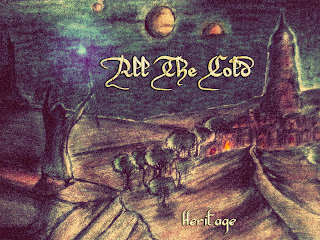
All the Cold - Heritage


Band: All the Cold
Album: Heritage
Genre:  Post-Metal (listed as progressive atmospheric rock)
Country: Russia
Year: 2013 

Listening to the new “All the Cold” album is like listening to a more ambient version of Alcest with more exploratory, jazzy rhythms reminiscent of recent words by Nokturnal Mortum and Drudkh, and less of Alcest’s dreamy or light quality. The track Zhu Zin exemplifies this mix of heavy and "mystical" qualities. Later electronic/synth effects might turn metal-fans off. It is “heavier” so to speak, but also filled with random riff sequences much more reminiscent of rock that bypass the entire “post-metal”/gaze concept. The data in the download describes it as “progressive atmospheric rock”. It still has its metal influence, as shown by how heavy it is, but it is light enough to move on a misty, progressive-rock uncertainty. It is melancholic, yet in the way that “Моєї мрії острови” was in Nokturnal Mortum’s Voices of Steel. Some parts event sound like the Death Note OST.

It certainly is a move away from their previous work One Year of Cold, which I reviewed about a week ago. I was surprised by how great the influence of progressive rock is, which usually is avoided by metal/post-metal BUT works out alright in this album, only adding to its sort of mysticism and flow.

The names, perhaps as implied by the title, are also not the familiar black-metal titles we are used to. Something echoes of an Arabian or Steppes mysticism in this work, like something of astronomy or minaret-towers quiet somewhere east of the Balkans, maybe east, maybe south.

Sometimes I think I’m listening to a funky electro-techno-nightcore-trance when I’m listening to this album. It isn’t bad, but it certainly is shocking. It isn’t disharmonic, but it’s not really black metal anymore. None of the black metal ambience is left from the previous album. I would say there is nothing similar about them.

Rated 7/10 for post-black metal/shoe-gaze for a unique mix of post-metal elements and electronic music. I can't really name another album like it.

Wednesday, April 3, 2013

All the Cold - One Year of Cold

 
Band: All the Cold 
Album: One Year of Cold
Genre: Ambient Black Metal/Ambient
Country: Russia
Year: 2009
Link

These guys have a split with Deep-pression. That alone made me give them a chance. My two favorites, tracks 01 and 05 of One Year of Cold, prompted me to listen to the album. Some people call All the Cold a DSBM band. I can see the influence, but there are too many uplifting cords and the neutrality of a calm landscape.

Track 01: "Last Winter" opens up... with the sound of winter. And some cool grungy guitars wallowing in the background, in a decayed world of urban hell. Or rather over a plain of winter. This ambient track picks up a little and stays the same throughout. There is a second part of the song, however, that seems like an entirely different song that comes from a fade-in-fade-out... it is pretty melancholic, ambient, metal. It sounds good, and the inclusion of a piano's withered notes bring back visions of the forgotten memories of some school girl at the piano. It captures the essence of a nation's sorrowful suspension, the age of waiting for a world, for an age. Waiting for something to happen. The guitars are really powerful and moving in this section although they are in the background and must be discerned from the main guitar riff, the piano and the drums. It is a typical DSBM riff but fits so well here and comes out in full power, though it is layered by the other sounds. 

Track 02: "Through the Dead World" is the best Ambient Black Metal song on here. They did wise to put it as the second track. It starts out good, like a typical Black Metal song, and progresses, reserved at first. At 1:23 finally we get the main riffs advancing up a diabolical, self-containing current. It is the forces of nature, of true man, waiting to be unleashed. The explosion of vocals doesn't come awkwardly and melds in with the riffs, making it fit. It is the scream of a soul. It is trve. 

Believe it or not, this song has lyrics and their execution is more melodic in this rasping scream than the vocals of bands like Drudkh. It is filtered through a grainy distance and comes like the true voice of a soul coming from miles and miles of ice frozen over in order to eventually break out, which it will by the end of this song. By 4:11, we realize this. Prepare for the most suspenseful, hunting, rushing-over-distant-plains fifty seconds of riff repetition you have ever experienced. The man is preparing for war. The soul is ready to be unleashed. Finally it comes at 5:00. 

The riff here is so beautiful and great, so melancholic, so reaching, so rushing, racing, running, burgeoning, the full weight of the soul. You stand at a top, a peak. There is nothing now. The entirety of your being pours fourth to this moment, along these currents for an eternity. The final exertion, towards which the song is building up but you don't realize, comes at 6:57. Then it fades out. And you aren't disappointed. 

The third track, "Coldly to Heart", starts out a bit clumsy with the synthesis of a high-pitch, flute-like synth and symbols. The guitars are very much confined to the background. It sounds somewhat like a medieval ballad. When the vocals start, they feel more misplaced than they did on the previous track. So does a heightened guitar. It continues like this. Its highs and lows are good. One of the shorter tracks. It ends soon. 

The next song is an ambient one. "New Day Without Me" starts off with prodding notes, not sure where they're going, testing the waters. As if you are lost somewhere. It is Burzum-esque. We start to get a kind of snow-effect, like a "sound of ice". I know it doesn't make much sense. But it's there. Small pinning notes are there in the background, like the tiny details of something you barely notice, like snowflakes, a pile of snow falling from a branch, an small animal running in between. At 5:06 we get the steady progression of a new current, and in contrast we can definitely hear the other two: the ice-sound and the constant pinning snow. There is a synth and a pensive chime, multiple ones actually which I will not all describe. I will let you delve into the soundscape yourselves for that. At 10:00 it fades out to the second part which seems like another song, a sort of trumpetous effect behind the sound of a constant rain. Then the vocalist says something. But at 12:17 we get a KICK ASS ending to this song. It's trve, especially after having listened to the calm soundscape for so long. It's inspiring, and uplifting, much against the notions of this band being plain DSBM. The rawness keeps repeating. I forgot this was the same song. It's so "active". At 15:11 it returns to a lower energy, in recompense from the epicness just having passed, and makes some very meaningful chords. They advance with a genuine solemnity. It only lasts so long before the song must end, having said its message.

Now to tack 05. I must write specially about it.

The ambient song that really kicks it off is "Message of Silent Space". I can't go into too much depth because it is extremely deep, spacious, because it is the sound of space itself. It starts out slow, with only a strange kind of rumbling effect with an indefinite echo. An ambient current rides in the background, calm, on which you ride and see. You are somewhere, although you might not know where. And yet it is nowhere. It is space. The simple pulls of an acoustic guitar accompany as if to represent the small musing and wandering of your soul within, its thoughts, its presence, its journey. Its persistence and subsistence within it, however small and insignificant from your singular vantage point. The string melody is anticipating something, a realization, leading up to it. It comes at 5:20. You listen after five minutes the distant pin-drops of probes and stars deep in the cosmos, never to return home, and when the guitars pick up, and the drums, you start to realize how hopeless this voyage really is, and that the journey is truly endless. You began this journey long ago, and you realize that you will never see the earth you left again, that the distant planet's existence has been lost to the eternity you find yourself in. You are leaving the sun, you are leaving the stars, you are leaving the arm of the galaxy into a depth never before explored, and to never be returned from. The height comes at 7:12. You press on, your ship made eternal through the endless depths as it will be eons and eternities before ever coming across another thing again, if it does. The chances are small. Whatever you are looking for, it is distant, and it will take eternity to get there. The ship continues on, silent, and you stare from the window of the captain's seat into the fore. All souls aboard, if you are not alone, think and feel and accept the same thing. But you are alone, nonetheless, for you will keep drifting for eternity. 

This song is perfect in its execution and leaves nothing lacking, it is simple, lengthy and worth it. I would have bought the album for this song alone. At 9:20 we come to a new point, the long end of our voyage, for however long we last. But we have been longing for this moment. It is our last glimpse of it, of the life remaining in these depths. It begins to fade out, like the lives aboard the ship, like the stars as the universe around you burns out with advanced age. Only the eldest clusters pass, as you are in a very deep and old part of space. The red giants extinguish one by one, the sky and clouds of nebulae turning dark. There is one last rise in the music until it fades indefinitely. 

TL;DR - Silent Message of Space is a great ambient track. Though not particularly large or memorable, it is special because its simplicity has no error or anything to dislike, with flawless execution and a perfect play. It is a "perfect" song despite if one likes it or not. 

"Last Sun Before Polar Night" reminds you that you are listening to Black Metal. It is one of the shorter songs, starting off with a fatalist, militant drum-line and guitar before falling into full Black Metal splendour. An uplifting synth cord is prevalent throughout. Reminiscent of wide open spaces and a sunset, as the title might suggest. 

"1941-1944. Kola North. War" is pretty much a short raw black metal song. Instrumental. Some okay to slightly-above-average riffs, fits in with the album. It's the shortest track.

"Nurman (Hymn of Cold Northern Town)" is an ambient piece with a piano giving it the reminiscence of a fairytale or a long forgotten memory in childhood, when times were simpler, and snow fell in the winters around quiet, memorable streets. Of an age as it passed away. Very high-pitched synth comes in at 1:24 and it either sounds awesome or totally cheesy, depending on your mood. If you're really caught up in the music, it's not grating to the ears. If not, it sounds digitized and fake. Again it switches to a second part around 2:50 and sounds like the wharves by the sea, the ambience of a rotting coastal village. We hear the sound of winds and a bleak sound effect. In the "third" part of the song, the melodies from before RETURN and it is pretty much the same song. Synth returns. (Sounds like a Gameboy's sound emitter.)

"Kingdom of Snow"... a very sentimental piece, the last one on the album. Starts out in a slow, recompensive look. Synth soundscape, hopeful little rises through the watchful and sullen ambiance. Then we get an echoing piano with a tune suggesting a spacious thing as well, following in line with the album's theme. I have a feeling that if the main synth chord was played on guitars, it would be pretty damn cool. But it reserves itself, floating only on synths, which makes it even more powerful because of the power it retains and suggests in the mind to complete for itself, to compensate if you will. Our last sample of vocals, whispery muttering by the singer. It fades out over a lengthy few seconds. The End.
Rated 8/10 for Ambient Black Metal for a mix of ambient black metal and ambient tracks

NB: times (e.g. 5:20) are according to the album version and not the TY videos, which are sometimes cut or mangled.

Friday, March 22, 2013

Writ and Wit

Wit is the word for knowledge, cognate Wissen in German. It refers to a kind of corporeal knowledge that we find in science and intelligence. 

Writ is anything that is written, as in the modern English word writ which is less used but in a select few cases that have become outdated, such as legal terms. A writ therefore can refer to any written work, being the word for writing, which I have divided into longwrit and curtwrit. Longer written works like novels and plays are longwrits while passages and articles are curtwrits. This goes into the realm of word-count and you can form systems further by referring to the most current charts for what constitutes novels and short stories. 

In an effort to provide a more Germanic vocabulary for English, which has been undertaken by some in the idea of Anglish, I have presented here a list of words I find most benefactual for use in English writing. The idea here isn't to replace all foreign-rooted words in English for the sake of purism, as is with the Anglish endeavor, but to provide simple alternatives that make more sense in a Germanic/Anglo-Saxon literary mind and can be used interchangeably with the current vocabulary. This is the best method for reinstating Anglo-Saxon vocabulary in its Germanic sense, and it also is built for the sake of language and literature rather than the other way around, which is taxing and obstructive to the goals of language and literature.

Thede - nation, people, race; actual archaism, cognate Deut in German. From this we can derive several more words that have since only used Latin roots: 

Thedeland - Germany, cognate Deutschland in German. Also could be Thedishland or Thedshland

Thedish - German, cognate Deutsch in German. Perhaps it could follow the same form as Swede and become the toponym Theden. Also use of Thedic

Bethede - to mean, signify, cognate Bedeuten in German; Betheding - meaning, sense, significance; Thedely - articulate, clear, distinct

From this convention we can also use Anglish and Angland to denote English and England. 


OTHER NOUNS

Lede - person, people, cognate Leute in German; exists in the sense of growing up from the soil, hence people in a specific area emphasizing closeness with the soil, such as in peasant classes. 

Evenland - Europe
Morrowland - Asia

Witship - science. Makes more sense than the commonly suggested Witcraft or Lore, because Witship cognates with German Wissenschaft and carries the same linguistic meaning, which is science. Because wit signifies the actual knowledge, ship does not need to be appended to logies like biology or astrology; astrology would be starwit and astrological science would be star witship. Lore is a poor suggestion because lore is akin to mythology, which is a memorized archetypal knowledge of unscientific things, while wit is scientific and is based on experimentation or intellectual evidence.

Heirship - dominion, reign, built after Herrenschaft in German using "Heir" as a term for Lord, carrying additional hereditary implications. The cognate with the German word would actually be Hoarship from the hoary color of a man's hair, whence the word Herr came.

Meanship - community, cognate Gemeinschaft in German

Sellship - society, cognate Gesellschaft in German

Talebook - novel, also use of Novelbook

Wordbook - dictionary, wordbook

Wort - plant, actual archaism

Bild, pict - picture 

Starswirl - galaxy, whorl starswirl - spiral galaxy

Roomwit - astronomy. Makes more sense than the commonly suggested Roomlore, because lore is akin to mythology and is not scientific.

Outsunnish wanderer - extrasolar planet

Waterstuff - hydrogen
Sunstuff - hellium 
Sourstuff - oxygen


VERBS

to ly - to like (pronounced lee), derived from the mutation of the suffix -like into -ly. By the same virtue, I have suggested Ry for Reich or Empire.  

to overset - to translate, cognate Uebersetzen in German

EXAMPLE

The signs from the Morrowland bedethe thoughts peculiar to the Morrowlandish lede. Their thedes comprise a distinct mindbild [psychology], with variation, reflecting the different elements of their meanship. Such things persist even in the era of witship's heirship, and will so long as the starswirl swings in the sky. These bedethings, of which there are thousands, are often objects of confusion to the thedes of Evenland, even in the face of the best efforts put forth by Thedish Morrowlandwitters in the past century. Masses of wordbooks are made to bridge this gap, but lede continue to ly remaining ignorant.

NOTES

This list is nowhere near complete nor is it intended to be. It is only for the benefit of the reader to form like-words through the methods above for their own writing. The ones I have mentioned are significant for one reason or another, which is why they are included here. 

Thanks to the Anglish Wikia (The Anglish Moot) for providing a history of Anglicization and calque techniques.

Wednesday, March 6, 2013

Kaula - Avadhuta Gita

Band: Kaula
Album: Avadhuta Gita Chapter 1 (supposedly not to release another one)
Genre: Experimental Black Metal
Country: Italy
Year: 2011

Extreme ritual black metal or extreme clanking scratching metal? "Kaula" describes itself as experimental black metal exploring themes of the Kali cult and the Avadhuta Gita of Hinduism, and their first and only album so far is "less an actual album than a spiritual quest".

One thing that's immediately noticeable is that the hooks are great - truly in the area of ritual black metal, as if to trap the listener in a trance back to the ancient empires beyond earth; after these follow the usual metal vocals, which aren't bad, but at this point you realize that they really are a "black metal" band and not ritual or ambient. These parts are good especially because the instrumentals are always in the background, and when the vocal denouements come we hear the guitars or whatever else is making that infernal noise grow louder as if the chants have actually summoned something.

Riffs are average and supported by ritual ambient effects (distortion/bass). This makes them a little better than the average riff. Vocals aren't droning and their brevity is almost Burzum-esque, but nothing else is.

Rated 6/10 for Black Metal for  ritual ambiance/noise, rare themes/lyrics.


"It also can be seen as the vision of one Pietro Riparbelli, an Italian artist who not only composed and recorded the whole thing throughout most of 2009 and 2010 but also designed its cryptic booklet and contributed with organs, medianic chants, field recordings and radio signals.

Defining himself as a "philosopher, composer and sound-multimedia artists based in Liverno, Italy", Riparbelli may have made for himself in the noise/experimental spheres with his main act
K11 -- with whom he put out a bunch of lo-fi mind-boggling through multiple respectable imprint like Old Europa Café, 20 Buck Spin, Actual Noise or Aurora Borealis -- but Kaula is a whole different beast that eludes any firm categorization and whose desire to strip the listener down of any preconceived notions and take him somewhere he's never been before is the backbone of one-a-kind project. Musically wise, what could be seen at first glance at some kind of weird black-metal outburst -- including rasping vocals courtesy of Rosy from old-school death-metal warriors - Profanal and buzzsaw guitars -- soon makes sure all rules go out the windows by using various metal (doom, thrash) and non-metal (noise industrial) elements and create a sonic black hole.

But it's really on the spiritual level -- or, say, on the conceptual level if you will - that Kaula really treads on uncharted territories. Keen to explore the Hindu culture and the cult of Kali in particular, all the lyrics are based here on ancient text called 'Avadhuta Gita', said to have been originally written in the IXth century. As a result, all seven tracks have been named after it and are basically about attaining a spiritual state "equivalent to the existence of god".

Suffice to say that mastered by Mell Dettmer, who've worked with SunnO))) and Earth among (many) others,
Kaula debut is a beast on its own."


*I must state that this probably shouldn't be listened to for enjoyment by anyone seeking to  destroy Kali worship, such as myself. From a spiritual point of view, this album threatens to strengthen the idea-forms of the Kali Yuga through individual psyches. 

** I couldn't find a place to download this from other than a Bandcamp page which charges you a euro. 


I felt like this album needed to be dealt with. Melodramatic Italians might have been pretentious in writing these descriptions, against which I can easily dismiss as something edgy. Other than the superb leads, I don't recommend this band.

Monday, March 4, 2013

Nostraman


This project is to decipher the language Nostraman from Aaron Dembski-Bowden’s Night Lords books from the Warhammer 40,000 universe. Nostraman is the third language used by the Eighth Legion, aside from High and Low Gothic, and is also their native tongue. Culturally it is set as an extremely poetic, “flowery” language that doesn’t translate well into English or any other language. Its customs are ruled by deceit, violence, base human nature and gang/mafia themes.

The analysis of this language will come from the examples pulled from the trilogy’s three books, Soul Hunter, Blood Reaver and Void Stalker. Not all examples have adequate context to translate them.

The method of analysis will be a comparative sequence to English sentences and patterns, which most likely are reflected in the text, “Kosh, kosh’eth tay…He’s saying thank you. Thank you, thank you very much. There are numerous places where the English pattern seems to surface in reflection to the gloss but within the Nostraman text.

The following are excerpts from the books which have, at least, some kind of context from which to draw translation:

CORPUS


Soul Hunter


Viris colratha dath sethicara tesh dasovallian. Solruthis veh za jass.
Sons of our father, stand in midnight clad. We bring the night. 

(When they are speaking about Septimus' eye:)

Athasavis te corunai tol shathen sha'shian? – (?)

Kosh, kosh'eth tay... Ama sho'shalnath mirsa tota. Ithis jasha. Ithis jasha nereoss. 
Thank you, thank you very much… Good color, very good color.
 
Jasca – Yes

Blood Reaver

Ashilla sorsollun, Ashilla uthullun – I am blind, I am cold
Vaya vey... ne’sha – I don’t… understand
Shrilla la lerril – whore that mates with dogs
Vellith sar’darithas, volvallasha sor sul – (-asha might mean “I” in some way)
Tosha amthilla van veshi laliss – This vessel is cursed.
Forfallian dal sur shissis lalil na sha dareel - We must be cautious, watch yourself
Sil vasha nuray – He has no arms

Void Stalker

Sinthallia shar vor vall’velias – That woman will be the death of us.
Corshia Sey – Breath now
Nishallitha – poisonous (p 165), since –llia is often a noun ending, -llitha is an adjective ending.
Athrillay, Vylasgreetings, brother
Vulusha, vulusha sethrishan?How, how much? 

Valmisai, shul’celadaan… Flishatha sey shol voroshica – Variel’s call to arms for Nostraman crew (p 344), perhaps with the phrase "Be ready now or die"

Vishi tha? – (p 347)
Ivalastitha – peace
Yrosia se naur tay helshival – smiling to mock me
Vel jaesha lai – I love you (?)
Juthai'lahPreysight
Valas Morovai – First Claw (First Squad)


LEXICON


Amthilla – vessel
Ashilla – I, or I am
Athasavis – eye, lens (?)
Athrillay – greetings
Dasovallia – being midnight clad, Dasovallitha – midnight clad (adjectival form)
Flisatha – ready, Flisa – prepared (?)
Forfallia – being cautious, Forfallitha – cautious
Ithis – color
Ivalastitha – peaceful, Ivalastia – peace
Nishallia – poison, Nishallitha – poisonous
Ruthis – absence (?)
Sinthallia – woman
Solruthis – night, “being wanting of sun” maybe, or “absence of sun” (sol – sun)
Sorsollia – sun that illuminates, Sorsollun – blind (lit. sunless)
Uthullia – sun that warms, Uthullun – cold (lit. sunless)
Valas – claw
Vallia – armor, cover, clad
Viris – sons
Vor – death
Vylas – brother (being addressed), possibly Vyla – brother

Corshia – to breathe (second person singular)
Vasha – to have (third person singular), veshi – third person singular inanimate
Vaya vey ne’sha – to not understand (first person singular)
Voroshica – to die (second person plural)
Yrosia – to smile (second person singular)

Jasha – good
Morovai – first
Nereoss – very
Kosh – thanks, Kosh’eth tay – thank you very much
Sey – now
Shol – or


MORPHOLOGY


Since both the Ashilla sorsollun and Sinthallia excerpts has the “to be” verb in their translation, perhaps the ending –illa itself means “is”, since it’s seen that not all nouns have the ending –illa but when the word “is” specifically occurs in translation.

-ll- if not the verb “to be”, it probably denotes the nominative declension case

-asha is contained in all first-person nouns, therefore “I”
-as is the only example we have of a singular second-person address, therefore “you”
-ia is contained in all third-person references, therefore “it”
-ay is contained in the only plural third-person reference, thus “they”
-is is contained once in a plural second-person reference, therefore possible “you all”, or an adjectival ending (ithis – color, solruthis – without sun)
-ian probably means “we”
-un means without

Possible Personal Declension, e.g. Vallia – armor
Vallasha – “I, armored”
Vallas – “you, armored”
Vallia – “it, armored”, “it, armor”
Vallian – “we, armored”

Kinship terms, from the two stated here (Vyla – brother, Vira – son) center around the v and l/r continuum, which is common in Latin (High Gothic) and Indo-European in general to denote the word “man” or “person”.

Nostraman is rife with apostrophes, being either a multiplicity of contractions as is common in degenerate languages, or a simple aesthetic motif which is common of scifi (I’m inclined to believe the former). Whether or not A.D.B. actually has a language – if he actually constructed the language of Nostraman and used it for the books – or has only made up the sentences as he’s gone on is unknown.

You can find links to the two earlier articles about Nostraman here:

The data from both of these works has been compiled into the present page. This is one of the most popular pages and hopefully it continues to be of use to you. 

Disclaimer: Soul Hunter and all other books, and their contents, released by Black Library are their property. I'm not stealing.